Showing posts with label narrative. Show all posts
Showing posts with label narrative. Show all posts
Wednesday, 10 February 2016
Production Log - Final Piece
With a few days left to complete our Film Noir production, we need to change a few things from the draft we previously did to make our production complete. For example, we need to edit the voiceovers to remove the sound of Matthew's voice. When we originally recorded the voiceovers he spoke and it is clear to hear in the film, so editing that out will improve the quality of our sound. Another thing we have to do is edit the footage shown in our first draft so that Heather's stumble is not noticeable. We've already re-filmed some of the footage so adding that in will eliminate our audience noticing Heather's trip. A final thing we may experiment with is where in our production the titles come up. Currently, they appear midway through the production, but after the comments we received from our survey we may analysis how it works at the start of our film instead.

Thursday, 4 February 2016
The Secret (First Draft)
After completing all of our filming, and a considerable amount of editing, we've successfully made a draft of our final piece. Bear in mind that this is not a completed version, and we plan to edit the piece more to improve certain aspects of it. For example, there are a few foley sounds missing that we need to record and add, such as the gunshot, but the purpose of this draft is to get a reaction from people. We will be showing it in class tomorrow, and handing out questionnaire's for people to fill out. This will allow us to see what the general reaction is from our class, and allow us to see the piece from someone else's perspective, giving us further ideas on how to improve it.
Our first draft is embed below through vimeo:
Below is the questionnaire we are going to show the class. Matthew created the questionnaire himself using google forms, so credit goes to him for it.

Our first draft is embed below through vimeo:
Below is the questionnaire we are going to show the class. Matthew created the questionnaire himself using google forms, so credit goes to him for it.

Reflection:
We feel that showing our draft to our class is a good idea because it allows us to get some quick feedback using the printouts Matthew created. Our next steps are to look in detail about the feedback we received and use it to further edit our piece to turn our draft into a completed piece.
Wednesday, 3 February 2016
In Depth Research of Opening Title Sequence
I previously did some research on an opening title sequence of a Film Noir. Having filmed and partly edited our piece, we've decided that we should do some more in depth research on the opening title sequence of a Film Noir. The post I previously did is here.
With this research, I'm going to analyse the same title sequence as I previously looked at before. However, this time I plan to analyse each part of the opening title sequence, and look at how the opening credits are shown to give us an idea an how we are going to edit them onto ours. The Film Noir I am analysing as before is the film 'Fallen Angel' from 1945. I've decided to show this as an Emaze presentation so that it is easier to view. The presentation can be seen below.

Reflection:
I think that this analysis of an opening title sequence of a Film Noir will be very useful to us when we are editing our piece because we will be able to use this Emaze presentation I have made to look at each title shown in a Film Noir. To make this better as a whole, I'd of liked to made the writing a little easier to read, but I am still new to the software of Emaze so am very pleased I've managed to create a full presentation and embed it on my blog successfully.
With this research, I'm going to analyse the same title sequence as I previously looked at before. However, this time I plan to analyse each part of the opening title sequence, and look at how the opening credits are shown to give us an idea an how we are going to edit them onto ours. The Film Noir I am analysing as before is the film 'Fallen Angel' from 1945. I've decided to show this as an Emaze presentation so that it is easier to view. The presentation can be seen below.
Reflection:
I think that this analysis of an opening title sequence of a Film Noir will be very useful to us when we are editing our piece because we will be able to use this Emaze presentation I have made to look at each title shown in a Film Noir. To make this better as a whole, I'd of liked to made the writing a little easier to read, but I am still new to the software of Emaze so am very pleased I've managed to create a full presentation and embed it on my blog successfully.
Thursday, 14 January 2016
Researching Sound
Another aspect of research I carried out was sound. I focused more on soundtracks, and in film sounds to see what conventions we will have to stick with for our Noir.
SoundTrack:
To understand the sound throughout a Film Noir, I first looked at the actual soundtracks that feature throughout the films. I used a website called All Music, which contained dozens of Film Noir soundtracks, and gave me and idea of the typical sounds throughout. The website for All Music and be accessed by the link below:
Film Noir sounds on All Music

From this, I was able to listen to the way the soundtracks are composed, and their general sound to give me some sort of idea of what we need to create for our final piece.
After looking on the website, it is clear to see that the genre's of Film Noir soundtracks are 'jazz' and 'electronic'. They seem to be played on old pianos, and violins. This means that for our final piece we will need to either recreate a piece of music like this ourselves, or find some music that is copyright free to embed into our production.
In Film Sounds:
In terms of in film sounds, I focused on one thing; voiceovers. I used a website called Vimeo to watch some openings to Film Noir's and see exactly how voiceovers are used. The link to Vimeo is below:
Film Noir's on Vimeo

From researching this, it became clear to see that each Noir had a voiceover at the start which explained the narrative. Because Film Noir's always traditionally start with the end of the film, the voiceover gives the audience an insight of exactly whats happened before to create this situation in the first place. This means that obviously we will try to match this convention to start our Noir at the end, and have a voiceover explaining exactly what has happened to create this situation.
Reflection:
Although this was only a brief piece of research, it was still vital for our group because it allowed us to understand the typical soundtracks used, and the way a voiceover is embed into a Noir to create the story line. Obviously to improve this task I could've done more in depth research, but I just wanted to gain some brief knowledge so that we have an idea on the sounds used. We may come back to this and do some more in depth research later on to gain us even more of an understanding. I learnt about the soundtracks used in Noir's from this research, and I now feel more confident with the knowledge of the conventions we must match.
SoundTrack:
To understand the sound throughout a Film Noir, I first looked at the actual soundtracks that feature throughout the films. I used a website called All Music, which contained dozens of Film Noir soundtracks, and gave me and idea of the typical sounds throughout. The website for All Music and be accessed by the link below:
Film Noir sounds on All Music

From this, I was able to listen to the way the soundtracks are composed, and their general sound to give me some sort of idea of what we need to create for our final piece.
After looking on the website, it is clear to see that the genre's of Film Noir soundtracks are 'jazz' and 'electronic'. They seem to be played on old pianos, and violins. This means that for our final piece we will need to either recreate a piece of music like this ourselves, or find some music that is copyright free to embed into our production.
In Film Sounds:
In terms of in film sounds, I focused on one thing; voiceovers. I used a website called Vimeo to watch some openings to Film Noir's and see exactly how voiceovers are used. The link to Vimeo is below:
Film Noir's on Vimeo

From researching this, it became clear to see that each Noir had a voiceover at the start which explained the narrative. Because Film Noir's always traditionally start with the end of the film, the voiceover gives the audience an insight of exactly whats happened before to create this situation in the first place. This means that obviously we will try to match this convention to start our Noir at the end, and have a voiceover explaining exactly what has happened to create this situation.
Reflection:
Although this was only a brief piece of research, it was still vital for our group because it allowed us to understand the typical soundtracks used, and the way a voiceover is embed into a Noir to create the story line. Obviously to improve this task I could've done more in depth research, but I just wanted to gain some brief knowledge so that we have an idea on the sounds used. We may come back to this and do some more in depth research later on to gain us even more of an understanding. I learnt about the soundtracks used in Noir's from this research, and I now feel more confident with the knowledge of the conventions we must match.
Research into Mise-En-Scene - Credit to Heather
Whilst I was carrying out research on location and Matthew was adapting the narrative, Heather did some research on mise-en-scene, and talked about the costume and props typical for a Film Noir. Her post can be seen in the screenshot below.

Reflection:
Splitting our group up to work on different aspects of research was very useful and proved effective for us because we were all able to come into lesson and work independently on different aspects of research. This also meant that if any of us had any free time, we knew exactly what we needed to be doing. We all learnt how much easier it is if we trust each other to do different parts of our planning and research, and how much quicker it can prove to be. To improve this post, Heather could add some links about the websites she visited, but the research she carried out is good.
Splitting our group up to work on different aspects of research was very useful and proved effective for us because we were all able to come into lesson and work independently on different aspects of research. This also meant that if any of us had any free time, we knew exactly what we needed to be doing. We all learnt how much easier it is if we trust each other to do different parts of our planning and research, and how much quicker it can prove to be. To improve this post, Heather could add some links about the websites she visited, but the research she carried out is good.
Thursday, 7 January 2016
Narrative Synopsis - Credit to Matthew
Whilst one of my roles was to research locations, one of Matthew's was to take all of the ideas we had discussed and put them into practise by creating a synopsis for our production. His post in relation to this is below:

Reflection:
This is an example of how dividing up the tasks was good for us because it meant that whilst I was carrying out research on possible locations, Matthew was working on our narrative which meant our planning time was moving forward quicker. Matthew did a good job here, and the synopsis he has created outlines exactly what happens in our film so that we are all aware of the plot. To improve, there could have been more detail used and perhaps a name for our character other than the 'femme fatal'. Having said this, I think that the synopsis created is very good and will help us move forward as a group and into the next stages of planning.
Thursday, 26 November 2015
Analysis of Narrative Structures
Now that we have decided on our genre (Film Noir) and planned a general synopsis of our production, we looked at some narrative structures that current films follow to give us an idea on how we need to adapt our ideas to fit a structure. We discarded most ideas because they simply didn't fit the style of a Film Noir, but managed to narrow it down to two ideas which can be seen below:


The first narrative structure is 'Vladimir Propp', and the whole idea of the structure revolves around the characters. If we were to adapt our narrative to suit this, we would have to create seven different characters to build up the plot. The whole idea of this structure is that every character has an effect on the way the plot pans out, and each of these characters has a role with exactly what they do in the relation to other characters. This structure would work, however we decided that as whole it wouldn't suit our production because we are only filming the opening title sequence, so even if we designed all of these characters we wouldn't actually be able to involve them in the filming process. Another reason why we decided against this type of structure is the fact that it doesn't follow the conventions of a Film Noir. Traditional Noir's start with the end of the film, and usually feature two main characters (the everyman, and the femme fatal), but the 'Vladimir Propp' structure features far too many characters, which simply wouldn't fit the conventions of a Film Noir.
The second narrative structure we looked at fully was the 'Enigma Code'. This structure is usually related to a mystery, and used in relation to genres of thrillers and crime. It is also designed so that the audience become instantly engaged with the film, and attempt to guess the solution of the mystery. Generally, this narrative structure fits a lot of the conventions of a Film Noir, which makes it more suitable for our production. For example, the fact that the structure relates to a mystery fits the conventions of a Film Noir because they are usually about a dramatic event that has happened which we spend the majority of the film trying to figure out. Another part of the structure that relates to the conventions is the fact it is common with genres related to thrillers and crime. These genres are related and feature throughout a Film Noir so this structure relates to it well. As a whole, the 'Enigma Code' is more suited to a Film Noir, so we can relate our ideas to this structure to help us construct the plot.
Reflection:
Analysing these narrative structures was very useful for us, because we were able to get an idea on what structures actual films follow. With these structures in mind, we have been able to relate the 'Enigma Code' to a Film Noir, so we can analyse the structure and possibly compare it to our synopsis to help us have a full understanding on the layout of the plot. From this task, we all learnt how important it is to know the structure of a film, and not just attempt to create a plot for a film without an idea on the direction it has to go. To improve this task we could've analysed more structures to give us an even better understanding, but we decided to discard the rest because they didn't relate to our idea of a Film Noir enough.


The first narrative structure is 'Vladimir Propp', and the whole idea of the structure revolves around the characters. If we were to adapt our narrative to suit this, we would have to create seven different characters to build up the plot. The whole idea of this structure is that every character has an effect on the way the plot pans out, and each of these characters has a role with exactly what they do in the relation to other characters. This structure would work, however we decided that as whole it wouldn't suit our production because we are only filming the opening title sequence, so even if we designed all of these characters we wouldn't actually be able to involve them in the filming process. Another reason why we decided against this type of structure is the fact that it doesn't follow the conventions of a Film Noir. Traditional Noir's start with the end of the film, and usually feature two main characters (the everyman, and the femme fatal), but the 'Vladimir Propp' structure features far too many characters, which simply wouldn't fit the conventions of a Film Noir.
The second narrative structure we looked at fully was the 'Enigma Code'. This structure is usually related to a mystery, and used in relation to genres of thrillers and crime. It is also designed so that the audience become instantly engaged with the film, and attempt to guess the solution of the mystery. Generally, this narrative structure fits a lot of the conventions of a Film Noir, which makes it more suitable for our production. For example, the fact that the structure relates to a mystery fits the conventions of a Film Noir because they are usually about a dramatic event that has happened which we spend the majority of the film trying to figure out. Another part of the structure that relates to the conventions is the fact it is common with genres related to thrillers and crime. These genres are related and feature throughout a Film Noir so this structure relates to it well. As a whole, the 'Enigma Code' is more suited to a Film Noir, so we can relate our ideas to this structure to help us construct the plot.
Reflection:
Analysing these narrative structures was very useful for us, because we were able to get an idea on what structures actual films follow. With these structures in mind, we have been able to relate the 'Enigma Code' to a Film Noir, so we can analyse the structure and possibly compare it to our synopsis to help us have a full understanding on the layout of the plot. From this task, we all learnt how important it is to know the structure of a film, and not just attempt to create a plot for a film without an idea on the direction it has to go. To improve this task we could've analysed more structures to give us an even better understanding, but we decided to discard the rest because they didn't relate to our idea of a Film Noir enough.
Narrative Starting Ideas
Our task for Media is to recreate an opening title sequence of a particular chosen genre. For my final piece, I am working with Matthew and Heather, and we have started to plan a narrative for our production and discussed different ideas for a story. We started by talking about a genre, and landed on the idea of recreating a Film Noir as much as we can. To do this, we will need to have a full understanding of the conventions that a Film Noir has, and attempt to recreate these into our production. Soon, we will allocate roles to each of us to ensure that we have that full understanding of this particular genre of film. Research will have to be done on things such as sound, so that we know what the soundtracks generally are, not to mention the way the dialogue is embedded. We will also need to research typical camera angles used, and the way that these films were edited, and how, not to mention the mise-en-scene, such as costumes and location. Another aspect of research will be the audience of a Film Noir; with an understanding of who these films were generally aimed at, we will have a good idea on the way we need to adapt our production to suit this particular type of audience. As a starting point, we talked as a group about possible ideas for our film and also about how many characters we would plan to have and what the general idea would be. From this, we were then able to write out a general synopsis of the narrative that we want our story to follow. Obviously this is just a starting idea so we will undoubtedly build on this idea and develop it in different ways.
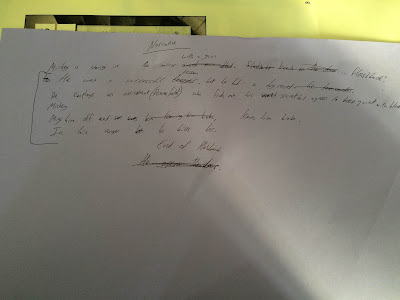

'Micky is staring in the mirror with a gun... Flashback:
He was a successful person, but he had a big secret.
He employs an assistant (femme-fatal) who finds out his secret but agrees to keep quiet by blackmailing Micky.
Leaves him broke.
In his anger he kills her.'
Reflection:
In terms of planning, this was a good starting point for us. We were able to pitch all of our possible ideas across to each other, and adapt each one as a group. This was also good because now that we have picked our genre (Film Noir), and created a general synopsis, we can move on to research and future planning for filming our production.
This task also had some negative aspects, which allowed each of us to learn what we need to do to improve as a group. The discussion we had about out genre and narrative took a long time, and we were quite indecisive at times about deciding exactly what direction we wanted our production to go in. With future discussions, we plan to try and be more decisive about the decisions we make, which will allow us to work faster and develop ideas quicker. If we had landed on a genre and narrative quicker, we could have adapted our piece further and perhaps starting thinking about other things such as a location for our filming, or what equipment we would use. Having said this, the synopsis above is a good starting point, and we are all happy with the ideas we have.
Subscribe to:
Posts (Atom)